


The Sutton Hoo Collection at the British Museum

I chose the Sutton Hoo collection at the British Museum for my research topic because I lived just three miles away from the ship-burial's excavation site back in the 1990s. The discovery of the Anglo-Saxon ship-burial dates back to 1939 when archaeologist, Basil Brown, famously excavated Mound 1 on Mrs. Edith Pretty's property in Suffolk. It turned out to be the richest archaeological find ever on British soil with priceless items of gold, silver, and precious stones.

As Basil's crew dug the mound they found iron rivets positioned at intervals that revealed the imprint of a ship almost 90 feet long. Once the grave goods were examined, the burial was dated to the early part of the 7th century AD and thought to belong to an important individual such as King Raedwald of East Anglia. The discovery of the Sutton Hoo hoard shed a light on the origins of the English people that little was known about and formerly coined "The Dark Ages."
One of the interesting facts that became apparent about Sutton Hoo soon after discovery was that a few items were not of Anglo-Saxon origin. The silver dishes (above) were all from the Byzantine Empire and 40 gold coins were each minted in different locations around modern day France.
The impressive gold objects were of Anglo-Saxon origin and demonstrated high craftsmanship in their intricate designs such as the purse lid, shoulder clasps, and buckle pictured above. However, recent research has revealed that the garnets in the gold items came from such faraway lands as Bohemia, India, and Sri Lanka. Therefore, the intercultural reach of the Anglo-Saxon people was much more distant than every thought before.
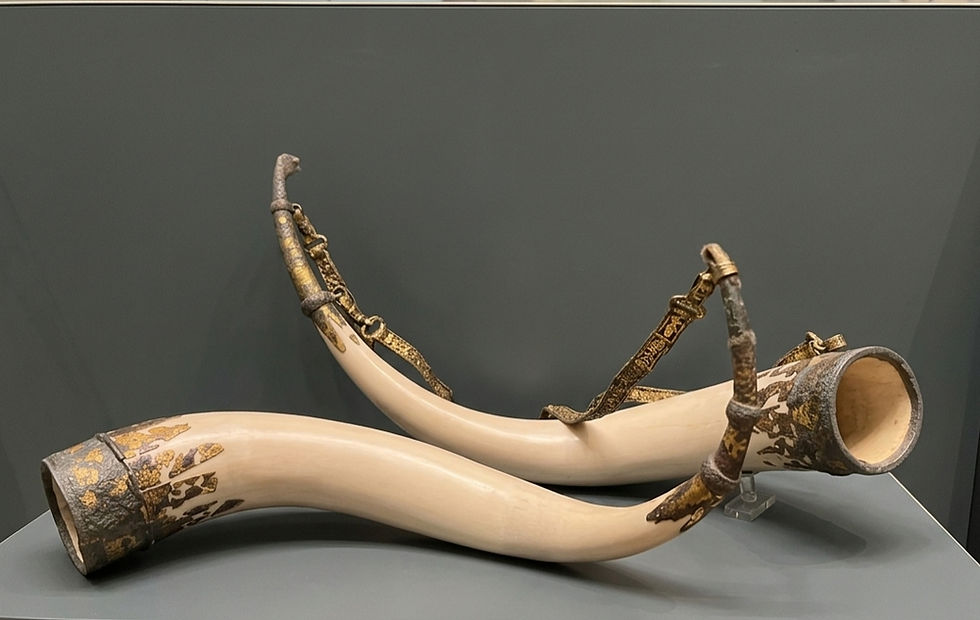
Several objects from the ship-burial additionally displayed Scandinavian influence such as the helmet, shield and weaponry. Ship-burials have also been unearthed in eastern Sweden. The reconstructed drinking horns pictured above with original silver mounts, came from a type of ox that was extinct at the time in Britain, and were most likely from the Continent.
I was lucky to see the Sutton Hoo collection because I found out during my research it will be traveling to France soon in exchange for the Bayeux Tapestry, which just arrived at the British Museum last week. Though I would absolutely love to see the Bayeux Tapestry, I really did need to view the Sutton Hoo objects and how they are presented in the museum for my research paper.
If you are interested in this story there is a book and movie called The Dig


Comments