


The Roman Baths: A Gorgon, Coins, & Curses
Updated: Jul 21

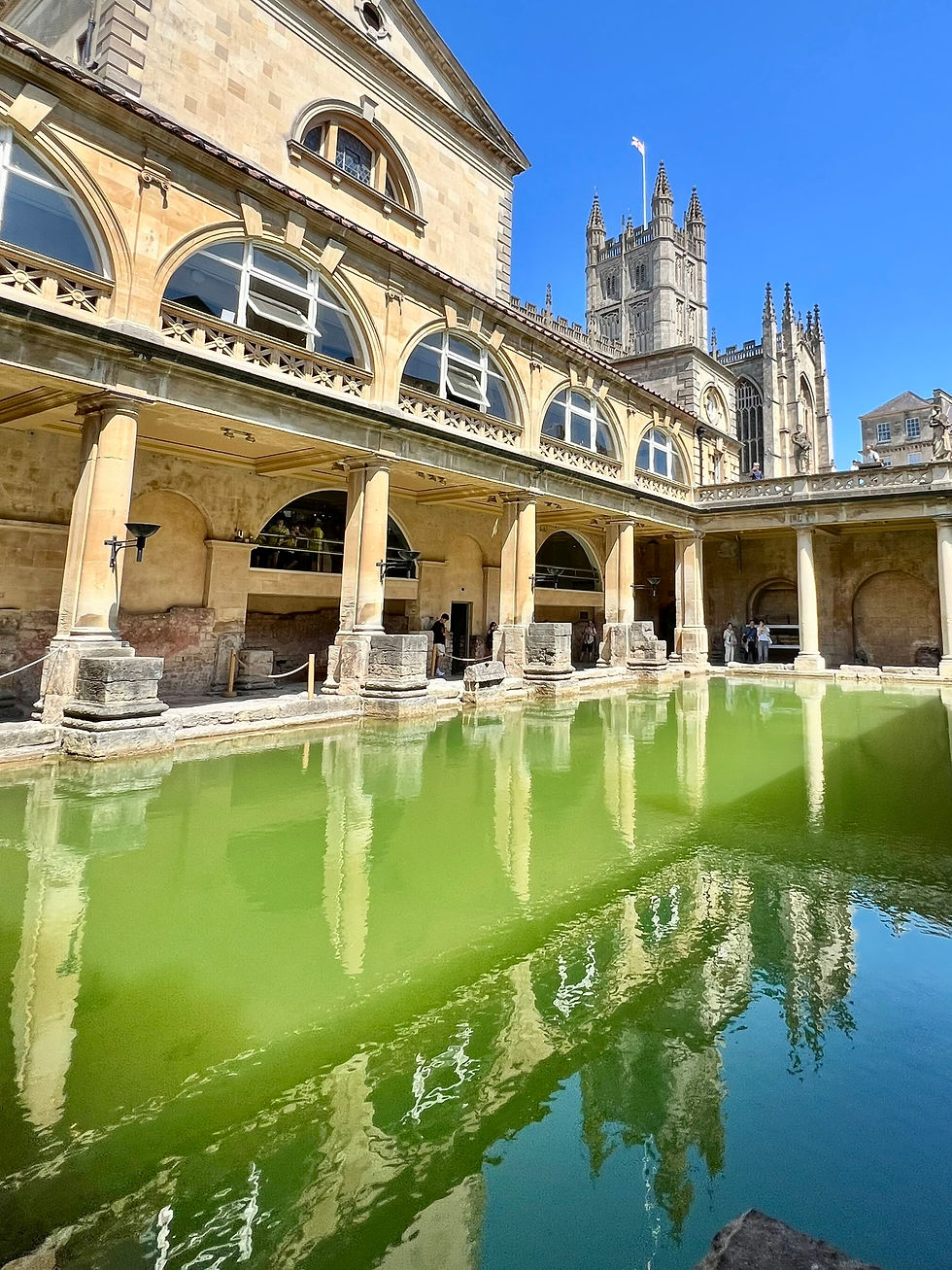
On Tuesday this week we took a 2-hour train ride from Paddington Station to Bath! We headed to the Roman Baths for our required site visit. I did not realize the complex was so large as I have seen the famous photos of the Great Bath that appears to be bright green and thought that was the main event, but there is so much more. Founded after the Roman invasion of Britannia in 43 AD, the complex also included the Sacred Spring (see below) for offerings, the Sulis Minerva Temple & courtyard, a cold plunge pool, heated rooms, the changing room & even a gymnasium for weight training! Who knew?

One of the features that fascinated me at the Roman Baths was the stone relief of a Gorgon (see below) that was originally located in the center of the pediment to the Temple of Sulis Minerva, now in pieces, but assembled for display. The Gorgon consists of a man's face with a stony gaze surrounded by snakes, wings & oak leaves. In Greek Mythology Gorgons are females like Medusa, so this Gorgon is immensely mysterious to scholars. He likely served as a protective guardian, keeping evil forces out of the space.
Another interesting discovery was this case full of Roman coins. At least 12,000 coins have been pulled out of the baths here. Because hot springs were viewed as gateways to the underworld, people tossed coins into the Sacred Spring as offerings, hoping to secure favors or forgiveness. This made me wonder if our modern custom of throwing coins into wishing wells and fountains originated from the Romans. Turns out that these types of offerings and beliefs were common among the Celts, Greeks, & Romans. The custom of tossing coins into an actual wishing well originated with German folklore.

The act of throwing curse tablets into the Sacred Spring was another intriguing custom. These tablets were made of thin layers of either pewter or lead, which were then etched to convey the curse. Interestingly, the text was scratched on backwards and this particular tablet cursed a thief!

Below is another view of the Great Bath, but this shot includes the Bath Abbey in the background, which was closed for graduation ceremonies on the day we were there. I love how the abbey reflects in the green water from this angle. The green hue is caused by algae that absolutely thrive in the hot, mineral-rich water. I tasted the warm spring water at the end of my tour, hopefully the awful taste was worth it if it brings me some kind of good health or luck!
Our day trip to Bath went quick and some of us raced over to the Jane Austen Centre before catching our train back to London. You can have tea at the Centre, but I had tea at Kensington Palace Orangery the day before & it's been hot, so tea would be much better in cooler weather. The Center has character actors & though the exhibition was a little underwhelming I am so glad that I went after I had some interaction with the cute guy playing Mr. Willoughby--even if it was just him asking me if I was there for the 2:00 tour and me getting tongue-tied and hardly remembering my name or what city I was in. Yeah, that was totally worth it!

Next up is the London Library!


Comments