


The National Museum of Scotland: A Visual Feast

Introduction
We entered the National Museum of Scotland at opening time and were rewarded with the experience of standing in the soaring and luminous Grand Gallery before the crowds arrived. I was in awe! The museum comprises two distinct architectural styles, the Victorian Grand Gallery previously known as the Royal Scottish Museum and the new Museum of Scotland that evokes the stone walls of Edinburgh Castle but with modern design. The two museums merged in 2011 and formed the National Museum of Scotland. While the Grand Gallery showcases global cultures, natural sciences, fashion, and technology, the modern wing focuses inward, charting the rich history of Scotland.

The Millennium Clock
While exploring the the Victorian building, I found the Millennium Clock tower to be an incredibly thought-provoking piece. The tower is made of scrap materials and dark wood and soars 10 meters high (over 32 feet). The tower was created by several artists in 1999 to commemorate the hopes, achievements, and tragic events from the previous millennium. Honestly, despite the tower's intention to commemorate hope, the darker elements of the piece completely overshadowed it for me. The monument feels profoundly macabre, as it incorporates chilling representations of death, Hitler, and the Holocaust. A video about the piece noted that instead of celebrating the millennium, the tower marks the end of the 20th century—a time that saw more senseless death than any other era in history. I completely agree with that sentiment! Every hour, the tower's mechanics awaken to music, utilizing a mirrored pendulum to reflect the crowd gathered around it.

Kingdom of the Scots
As someone unfamiliar with Scottish history, I was eager to learn more by exploring the 'Kingdoms of Scotland' galleries in the modern wing. I knew the Lewis Chessmen were famous, but now I can see why. I was drawn to their bulging eyes and various facial expressions. They are finely carved from walrus ivory and whale teeth. I particularly loved the queen pieces, who I think look bored, but others think the hand on the cheek may symbolize wisdom or mourning. The museum has just 11 pieces, but the British Museum has dozens.

I learned that the early historical groups of people found in Scotland were the Picts, the Britons, and the Angles. Now, why have I included a photo of a tiny gold pyramid with garnets below? This pyramid was of Angle origin and was a decorative accessory for a sword. I was excited to see the piece because it is similar to those found in the Sutton Hoo ship burial, which belongs to the collection that serves as the focus of my research. I thought it was thrilling to find a connection in craftsmanship and design between the Angles of Scotland and the Anglo-Saxons of Sutton Hoo, England. I'll be viewing the Sutton Hoo hoard at the British Museum in a couple of weeks.

Rooftop Terrace
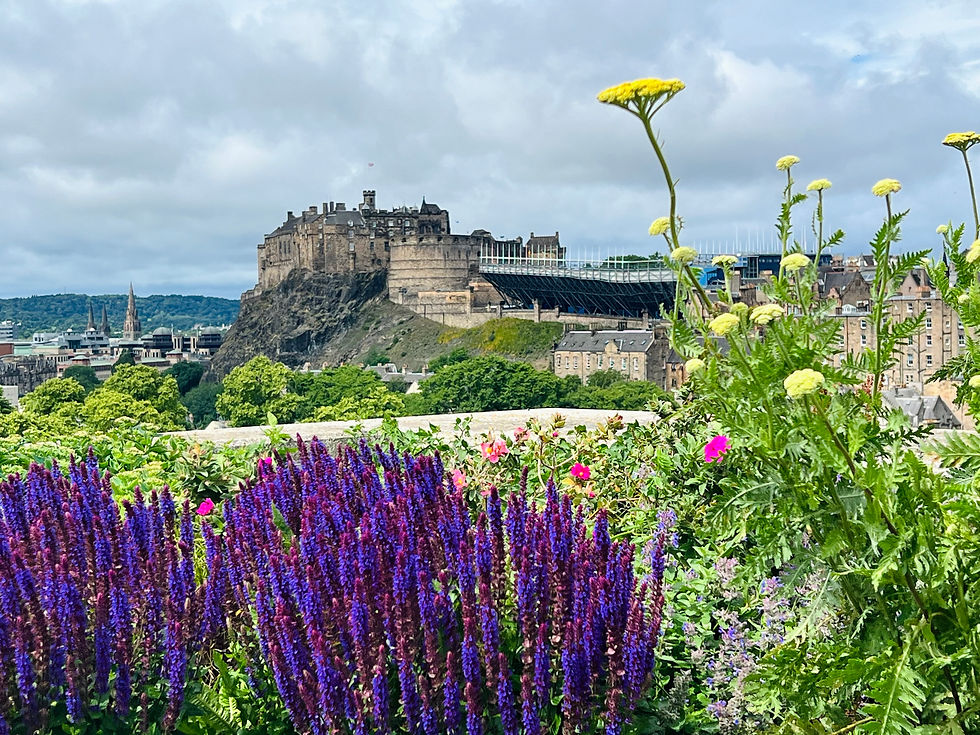
The museum’s visual feast peaked on the rooftop terrace, where I took in the spectacular views of Edinburgh and the castle framed by colorful flowers.


Comments